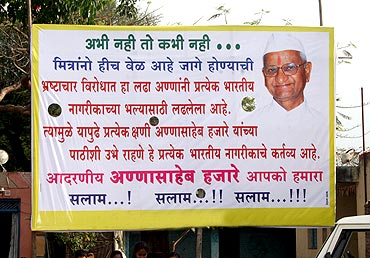
Saturday, August 20, 2011

LOKPAL BILL

सरकार ने कहा कि इस सत्र में बिल पास होना संभव नहीं...
जब एक दिन में सांसदों कि सैलरी बढ़ाने का बिल पास हो सकता है...
तो तीस अगस्त तक जन लोकपाल का बिल क्यों नहीं पास हो सकता...
अपने विचार जरूर लिखिए..

Anna's village, now a tourist hot spot?

Anna's village, now a tourist hot spot?


Anna Hazare's small village Ralegan Siddhi has now turned out to be a tourist hot spot with guided tours. This model village in Maharashtra has been witnessing tourists and outsiders dropping in just to have a look at Anna, the hero's residence.

Mahesh Nimbalkar and his family travelled 150 km to see Anna's little 8x10 room in Yadavbaba Temple. But, this isn't the end. In fact, tourists, hailing from abroad are flocking in this small Indian village. Maggie and Rachel have come all the way from UK to visit the icon's small village.

And the village has made sure that for all those visiting, their energy and enthusiasm is on full display.

With the kind of response the movement has got, one wonders if tourists will flock-in in large numbers to have their chance to peek at the man who's become a national icon when he returns to his village.

Wear Black T-shirt or Black Shirt 2day to support Anna


Wear Black T-shirt or Black Shirt 2day to support Anna


Wear Black T-shirt or Black Shirt 2day to support Anna Hazare n spread dis msg among Indians n friends,relatives, colleagues..Entire Country will wear Black 2day Jai Hind..We all support ANNAji, for his war against "CORRUPTION".This movement is not against any government it is against the corruption which is ruining the future of Our """YOUTH "".We have to unite and fight for the cause,it shall continue until "corruption" is eradicated completely from our country INDIA...All Indians Means ,,,Hindu/Muslim/Sikh/Christians...All INDIANS Join Now

Right to Information by ANNA HAZARE


Right to Information


India celebrated its first Republic Day on 26th January 1950. That day, India became a sovereign republic nation. The government exchequer collected by different ways ultimately belongs to the citizens of the country. Citizens elect their representatives and send them to the Lok Sabha and Vidhan Sabha for managing the public money. The people’s representatives are actually public servants. As they are public servants, their position is secondary to that of citizens. But, unfortunately, this fact has not been realized by the people in the last 60 years of Independence. Some people with vested interest deliberately kept the citizens in darkness. Citizens are at the helm of affairs in democracy, nobody is beyond them.


The President of India appoints Civil Servants in Indian Administrative Services (IAS), Indian Police Services (IPS) and Indian Forest Services (IFS). The People’s Representatives and the Civil Servants are ultimately the public servants. They have to serve the citizens. But, the picture is altogether different today. The People’s Representatives and the Civil Servants have become masters of the country and made the citizens poor servants.


In the Maharashtra State, a campaign was started demanding for the Right to Information. As Peoples Representatives and Civil Servants are public servants and the citizens of Maharashtra are owners of the public money, the citizens have the right to ask the public servants how and in what manner they spend the public money. He pressed for legislating an Act for Right to Information. The first campaign was organized at the Azad Maidan, Mumbai, in 1997. The State Government was giving only promises, but it failed to crystallize it in many sessions of the Vidhan Sabha. He had to make agitations, dharnas, morchas, maun and fasts many times.  


  State-wide tours were held for awareness generation among people. Public addresses were organized in many towns and programmes were arranged specially for college students. Posters, banners and folders were printed and distributed in thousands. All this resulted in the awakening of the citizens and making them aware of their fundamental Right to Information.

The Government made many promises, but it failed to keep one. Any government never wants to decentralize its power and hand over power to people. Many politicians think that decentralization of power will lessen
their importance, status and respect. So the Government was reluctant to make legislation for Right to Information.

Finally, with zeal of ‘do-or-die’, Mr. Hazare went on fast-unto-death on August 9, 2003 at Azad Maidan, Mumbai. He decided that unless the Act is passed by the Government, he will not end his fast; rather he will sacrifice his life for peoples rights.

The Government of Maharashtra felt that his resolution is firm and He would not step back from his decision of ‘do-or-die’. On the 12th day of his fast, the Government of Maharashtra got the Bill signed by the President of India and enacted the law of ‘Right to Information’ in Maharashtra. The Act on ‘Right to Information’ is a revolutionary step towards strengthening democracy.  

This Act has enabled the common man to seek information. Till to-date, the people have to obey the laws; whereas the government machinery controlled everything. But by the advent of this Act, the Government Agencies have to obey the law and the people have got controlling power.

This Act should have come into force on 26th February 1950 itself; the day India celebrated its first Republic Day. This would have brought transparency and accountability in every transaction of the government and would have checked corruption to a great extent. The erstwhile British rulers had prohibited people from getting any information by creating the Official Secrets Act. The following Indian governments maintained status quo by not amending the Act as it provided them space for corruption. The British Act of Official Secrets was in force for almost 58 years after British left India. This Act gave the weapon in the hands of corrupt politicians and officers to exploit the common man.

Under the guise of the Official secrets Act, information was denied to people. So he started the movement for Right to Information. In freedom, every citizen has fundamental right to know how the public money is spent.The question to the Government was "Why do you deny information which is not confidential" under the guise of Official Secrets Act? Finally, the government had to make the Right to Information Act.

Due to this Act, transparency has come in in the administration. Now a common man can get information by just paying a nominal charge of Rs. 10 or 20. This has paved the way to good governance and healthy democracy.

If this Act reaches every village and every household, it has potential to check corruption to an extent of 80 – 85%. Due to corruption, only 10 percent could reach the real beneficiaries of the poverty alleviation programmes earlier. Rest of the money percolated to the purses of corrupt officers and politicians. Now, due to the Act of Right to Information, the poor villagers will get their due share in the development process. The quality of project works has started to improve after the Act.

Central Government stopped amendments in Right to Information Act:
  It is a positive step after 58 years of Independence to enact the Right to Information Act. But as this Act has potential to check corruption to a great extent, some politicians felt it as a hurdle in their corrupt practices. Prime Minister Mr. Manmohan Singh’s Government tabled a Bill for amendments in the existing Act which were detrimental to the very cause of the Act. Citizens had got these rights after 58 years of Independence after a long struggle. The proposed amendments were going to nullify these rights. To protest against the amendments, Mr. Hazareundertook fast unto death at Alandi near Pune.

Within two days of commencing his fast, people in various parts of Maharashtra started agitation on their own in support of my demand. People undertook ‘Rail-roko-andolan’ (train blockade) at nine places.
Gradually, the agitation spread to other parts of India. Even some Indians residing in the US went on fast in support of my agitation. Prime Minister Mr. Manmohan Singh sent one of his Ministers as emissary to Alandi, as the agitation gathered momentum in and outside the country, and promised that the existing Right to Information Act would not be amended by the Central Government. He requested Mr. Hazare to end his fast and he gave it up on 9th day. Fortunately, the Government gave up the idea of proposed amendments in the Right to Information Act.


Act for Regulating Transfers:

As there was no clear-cut policy on transfers of the Government Officers, the People’s Representatives and Senior Officers of the government misused their power to transfer the government servants as per their wish. In these transfers, usually money changes hands. Thus, a transfer was a source of bribery.

If an elected Representative wants his relative or confident to be posted in a key position where an honest Officer is already working, he would misuse his power to get the honest man transferred to other place; thus creating vacancy to bring his man to that position. This was injustice to the honest officer.

To prevent this type of injustice, He started a movement for legislation of an Act which would prevent transfer of any officer, at the will of his superiors or political heavy weights, for a minimum period of three years. It was also ensured that no officer will continue at the same place for more than three years. The local politicians like Members of the Lok Sabha and Vidhan Sabha, Ministers in the Government and Senior Officers of the Government opposed legislation of this Act as it was going to affect their vested interest.


Due to this act, the honest officers got some relief and the corruption involved in transfers has reduced to a large extent.


More Rights for Gram Sabha:

  Gram Sabha is a Village Parliament; just like Lok Sabha and Vidhan Sabha being parliaments at Central and State levels respectively, in the Indian parliamentary system of democracy. Gram Sabha is supreme in the democratic set-up. Any villager who attains the age of 18 years automatically becomes a member of the Gram Sabha according to provisions in the Indian Constitution. Villagers, who are eligible for casting their votes by virtue of their age, are the members of the Gram Sabha. There is no election for constituting the Gram Sabha as in the case of Lok Sabha or Vidhan Sabha. It is an autonomous and sovereign body. The members of the Gram Sabha elect the members of the Lok Sabha and Vidhan Sabha through elections who subsequently form the
Lok Sabha and Vidhan Sabha. Thus, the Gram Sabha is the mother of Lok Sabha and Vidhan Sabha. The Ministry of the Government, may it be at Central or State level, has to take the Lok Sabha or Vidhan Sabha into confidence for undertaking any developmental programme. In the same way, the Gram Panchayat, i.e. the elected body at village level, should take the Gram Sabha into confidence before undertaking developmental programmes.

A peoples movement was carried out for 7 years for legislation for granting more rights to Gram Sabha. Finally, the State Govt. of Maharashtra passed an Act granting more rights to Gram Sabha. Now, it is made mandatory for the Gram Panchayat to take permission of the Gram Sabha before spending the money it receives from the government for different developmental programmes. If it is found that the Gram Panchayat did not take permission of the Gram Sabha and spent the money without information to the Gram Sabha, then the villagers (minimum 20% of voters) could approach the Chief Executive Officer (CEO) of the Zilla Parishad for an enquiry into the expenditure. The CEO has to make an enquiry within a month and, if he is convinced that the money has been spent without the knowledge of the Gram Sabha, send his report to the Divisional Commissioner recommending for legal action. There is provision in the Act that the Divisional Commissioner can dismiss the Sarpanch (Head of the Gram Panchayat), the Deputy Sarpanch and the Gram Sevak (Village Development Officer).
The Act has helped in bringing transparency in village development schemes and thus curbing corruption to a great extent. Every citizen has a right to elect his representative in the democracy. In the same way, he should also have a right to recall the elected representative. This Act has given this right to recall to the villagers. This will foster a healthy and people-oriented democracy. There is a need for awareness generation and educating people to use this Act for bringing more transparency in the development programmes.

A Decade of Struggle

Anna Hazare had to struggle for 11 years continuously against government for giving rights to citizens by making legislations for Right to Information, More Rights for the Gram Sabha, Regulating Transfers of the Government Officers, Prohibition and against Red Tapism.

  After the ShivSena – BJP government came in power on March 11, 1995; Anna Hazare started communicating with the government for taking steps to curb corruption. He wrote to the government 15 times and had meetings with it.


  He sent a letter to the government on January 12, 1998 asking it to make an act for Right to Information for checking corruption.


  As government was not paying any heed to his demand even after writing many letters and discussions, he started dharna on April 6, 1995 at the Azad Maidan, Mumbai.


  He again wrote to the government 10 times between April 6, 1998 and August 2, 1999 asking it to make the Act for Right to Information. In the mean time, Congress – NCP government came in power.


  He communicated with the newly formed government 5 times pressing it to make the Act. As it failed to do this, he wrote to the govt. on April 6, 2000 warning it that a statewide dharna agitation in front of Collector Offices would be started from 1st may and he would go on fast from 20th May, 2000.


  As per schedule, the dharna agitation started in front of all Collector Offices all over the state on 2nd May. The fast was postponed as the Central Government passed a bill in Lok Sabha on Information Technology.


  Continued communication with the govt. Wrote 14 times and had meetings with the govt. One year lapsed.


  On 1st March 2001, wrote to the govt. that he would start statewide maun andolan from 1st May if the govt. did not make the legislation. The Chief Minister held a meeting with other concerned ministers and Secretaries and made a promise that the govt. will pass the bill in the coming session.


  After the promise from the Chief Minister, 81 days lapsed. Anna’s correspondence with the govt. was continued. He wrote again on 1st March 2001 telling that he would undertake maun on 9th August 2001 at his native village Ralegan Siddhi.


  As per his warning, he started maun agitation on 9th August. On the same day, people started agitation all over Maharashtra.


  After 4 days of maun, the Minister of Law and Justice Mr. Vilas Kaka Undalkar visited Ralegan Siddhi to discuss with Anna Hazare. He facilitated a telephonic discussion with the Chief Minister and the Chief Secretary of Maharashtra. After promise from them, Anna stopped his maun.


  After the lapse of 1 year and a month and writing more than 15 letters, the govt. was not taking any action. So Anna started maun again on 21st Sept. 2002. After 5 days, four Ministers of the maharashtra Govt., viz. Mr. Dilip Valse Patil, Shivajirao Kardile, Shivajirao Moghe and R. R. Patil came to Ralegan Siddhi for discussions with Anna Hazare. After getting a written assurance from the Chief Minister and Chief secretary, Anna stopped his agitation.


  A meeting between Anna Hazare and the govt. was held on 30th October 2002 at Mumbai where the Chief Minister, the Chief secretary, other ministers and senior officers participated in the meeting on behalf of the govt. Again a promise was made.


  But as the govt. was not kepi ng its promise, Anna again warned on 21st January that he would undertake agitation on 20th February at Mumbai.


  In the men time, the Chief minister of Maharashtra got changed. The new CM Mr. Sushilkumar Shinde informed Anna Hazare that a solution would be found within a timeframe after a meeting with Ministers and Senior Officers. So Anna postponed his agitation.


  A high level meeting was held at the Secretariat in Mumbai on 17th February and the CM promised that appropriate action would be taken.


  After the failure of the govt. to keep its words, Anna again warned the govt. of agitation from August 9, 2003 at Mumbai.


  Anna finally went on fast on 9th August 2003 at the Azad Maidan in Mumbai. Thousands of people from all over Maharashtra gathered at the site of fast in support of his agitation. At the same time, people also protested at Collector Offices at all district headquarters. All this mounted tremendous pressure on the govt. There was a threat of govt. collapse if the Act was not passed. Finaly, the President of India signed the Bill on 12th day of Anna’s fast and declared that the Act would be effective from 2002. Anna ended his fast at the hands of a noted Social Worker Mr. Tukaramdada Gitacharya.


  The Right to Information Act came into effect in Maharashtra from 2002. With Anna’s persuasion, the same Act came into effect for the whole nation.


  Likewise, the Acts for more rights to the Gram Sabha and against Red Tapism were passed by the government.

These Acts are revolutionary steps towards strengthening of democracy in Maharashtra.


Wake Up INDIA Wake Up..!!!


Wake Up INDIA Wake Up..!!!

 
Kya aap jante hain 400 Lakh Crore agar vapas aayega to kya hoga?
1. India will be financialy on 1st position.
2. Ek jille ko 60,000 Crore milega aur ek gaon ko 100 Crore milega.
3. No tax for 20 years.
4. Petrol Rs.25/Ltr
...• Diesel Rs.15/Ltr
• CNG Rs.15/Kg
5. India ki border charon taraf se china wall se bhi jyada strong banegi
6. 28000Kms ki Rubber ki road (like PARIS) taiyar ho sakti hai

Wake Up INDIA Wake Up..!!!

Friday, August 19, 2011

Anti-corrupotion movement by ANNA

Anti-corrupotion movement

Power Situation during 1985-86 became extremely critical. The farmers were unable to lift water from the wells inspite of its availability due to insufficient voltage to run pumps. The motors were getting burnt due to fluctuations and the crops were getting affected. There was scant response from the govt. inspite of continuous follow-up. On 28th Nov. 1989 Mr. Hazare was forced to undertake fast for seeking redressal. After 8 days of his fast , his health deteriorated and was admitted in the civil hospital at Ahmednagar. As there was, no response inspite of action from his side, the farmers from three tehsils became furious and they started road block agitation. Fearing that if the agitation takes a wrong turn, something untoward may take place. He appealed to the agitators from the hospital bed that they should not resort to unfair means, damage the national property and inflict any harm to the passengers. The agitation should be peaceful. The police authorities did not expect huge participation and there was meager police force available.


However, they were proved wrong and more than 10000 men and 1200 women participated in the agitation. The agitators had offered police to take them to jail. However, since enough transport was not available with the police, the police tried to remove the road block. Due to improper treatment meted out to the agitators, there was scuffle between police and the agitators and the police resorted to lathi-charged on agitators. This action on the part of police irritated them and they pelted stones on the police force. Since the situation was going out of control, additional force was called and police opened fire on the agitators in which 4 farmers died on the spot and 7 farmers sustained severe injuries. He felt sad on hearing this news in the hospital. The agitation was meant for awakening the government and there is no harm in carrying out such agitations in democracy. He had decided to end his life during the fast itself, but Senior Officials of the government and even Ministers persuaded him to give up his fast as they feared that if agitation continues, lot many farmers may lose their life and in order to save the life of innocent farmers, he withdrew his fast.


Model Village as contemplated by Gandhiji was brought in reality by Shri Annaji at Ralegan Siddhi by his dedication. “Late Shri Achyutrao Patwardhan, the great freedom fighter, suggested to the government of Maharashtra that to commemorate the golden jubilee of Bharat Chhodo Andolan, it would be most befitting to create model villages like Ralegan Siddhi in every tehsil of the state.  The government accepted this suggestion and declared to implement “Adarsh Gaon Yojana”. The Government entrusted this responsibility to him and Adarsha Gaon Yojana was started under his leadership . He travelled whole of Maharashtra and selected 300 villages to implement this scheme. While working in this scheme

he realised that development is getting hampered due to planned corruption in Govermnent machinery and he decided to fight against this corruption. He gave evidence against two ministers who had amassed wealth disproportionate to their income. However since the Govt was passive about this he started agitation and undertook fast for l0 days. Chief Minister intervened and he deleted these two ministers from ministry and appointed an Inquiry Commission. The Commission held both the ministers guilty but to save them the Govt appointed another commission who discharged them from the allegations. Though the ministers were discharged from the allegations, they had to loose their ministership which is the success of Mr.Hazare's agitation.


Mr.Hazare's gave evidence of corruption by Social Welfare Minister to the then Chief Minister. On 3lst July l999 the Chief Minister informed him that inquiry is being instituted about the charges leveled by him. He had given an interview to a local daily regarding this inquiry and based on this interview the concerned minister had filed a case in the court against Mr.Hazare for defamation. He was held guilty by the Court and the court had asked him to give an undertaking that he will not make such allegations in future.He refused to give such undertaking and preferred to go jail for 3 months as ordered by the court. He told the court that He was willing to give his life for truth. His punishment created commotion in public and scores of people started visiting Yerawada Jail.
   

He wanted to compelte his jail term but to give respect to the public feelings he accepted his release.In l992 Gandhji had told the court that if court feels that his actions for the freedom of the country are considered as anti government activities he was willing to undergo any punishment .Similarly he did not give bond to the court and accpeted punishment. He did not prefer any appeal against the court order immediately but due to public pressure he later made an appeal which was upheld by the Higher Court and rejected the suit of minister.Mr. Hazare asked the Govt. to conduct the inquiry against the minister which is still on.


In the regim of coaliation Government of Congress and National Congress Party, He had forwarded evidence of corruption about 4 ministers and had asked the Government to conduct inquiry. One of the ministers had made allegations about corruption in the institutions in which he was associated. Since there was no action from the Govt. he undertook fast for 9 dys in August 2003 at Azad Maidan. The minister concenred also started agitation at Azaj Maidan in Mumbai. At last the Government relented and Retired Suprement Court Judge Shri P.B. Sawant was appointed to conduct the inquiry. The commission conducted the inquiry and sent its report to Govt. on 22nd Februrary .

In the report the commission had observed ministers guilty and had held Mr.Hazare also guilty forirregularities but not a single charge of corruption was proved against him.Mr. Hazare has offered the Government that it should take action against him as well as the ministers based on the findings of the enquiry comissions.Though Govt has not taken any action on the Commission's report three ministers had to go and this is a big achievement of his agitation against corruption.


He felt that corruption will not stop merely by taking action against a few officers and ministers and it is necessary that a change should be brought about in the system, He believes that unless decentralisation of power takes place the system will not change.In order to bring change in the system he felt that information should be made available to people regarding Govt.'s actions which was not being provided to people on the ground of secracy. Here again he decided to follow Gandhiji's path and started Maun Vrat and later fast unto death. This brought pressure on the Govt. and both the Central as well as State Governments have enacted Right to Information Act. His whole life and work is based on Gandhian philosophy.


Prohibition


Alcohol has ruined many families in rural India. The existing laws did not have teeth to ban the sale of alcohol in villages. So he decided to press the government to make a law for prohibition if 50% women demanded for it. Ultimately, women are the most affected lot if their husbands are drunkards.


By the new Act, the women of any village can collectively demand for ban on sale of alcoholic drinks in the village. If a minimum of 50% of women complain to the District Collector about their sufferings and request for total prohibition in the village, the Collector can hold ballot paper election in the village. There will be two signs on the paper – one being a bottle in standing position and another being in a horizontal position. The women will cast their votes. In the evening, the votes will be counted. If more votes are in favour of ‘horizontal bottle’, then the Collector will ban the sale of alcoholic drinks in the village and cancel the license of the seller.


In many villages, the licenses have been cancelled and total prohibition came into reality after this Act. In some villages, the alcohol sellers have manipulated the election with money power.


Anyhow, this Act has supported and strengthened the women. Women have become empowered due to this act and became fearless to come in open against the alcoholism. This Act has helped in organizing the women and fight against evils for a common good. Women’s empowerment is the need of the day.

RALEGAN SIDDHI(ANNA's Village) : A MODEL OF SUSTAINABLE DEVELOPMENT


RALEGAN SIDDHI : A MODEL OF SUSTAINABLE DEVELOPMENT

Swami Vivekananda’s philosophy has great bearing on Anna Hazare. His thoughts and work have been a constant source of inspiration for him. While serving in the Indian Army, he had decided to dedicate his life to social work, but he did not know how to begin.
 
While in the army, he used to visit his village for two months, every year during his leave period. The condition of the village was pathetic and awful. The land was barren and undulated. As the village is located in the rain-shadow area, the annual rainfall is a meager 400–500 mm. All of the rainwater use to run off and get wasted. There were no means to harvest this precious resource. Whatever rainwater use to get collected was sufficient to cultivate only one crop on 300–350 acres of land out of a total 2200 acres of land available in village. 80% families were surviving on one square meal in a day.

As food production was insufficient and no employment opportunities were available in the village, some villagers started brewing liquor to earn their livelihood. Gradually the number of breweries rose to 35. They were aware that what they were doing was socially and morally incorrect, but the circumstances forced them to adopt this profession for their livelihood. Some villagers had to walk 5–6 km. each day in search of employment in the nearby villages.

The helplessness due to poverty and indebtedness led people to desperation and ultimately to alcoholism. Quarrels and street fights became daily chores. Hazare’s house was in a hamlet just half a km. away from the centre of the village. Hazare avoided going to the heart of the village due to this pathetic condition. He always felt helpless since he could not do anything to change the conditions prevailing in the village.

When he decided to dedicate his life for social cause in 1975, he believed charity should begin from home. Swami Vivekananda’s words resonated in his mind - people would not listen to philosophical ideologies with empty stomachs. Social change is not possible if people are haunted by the daily problem of making two ends meet. Hazare taxed his brains on how to solve this crucial problem. He remembered that Late Mr. Vilasrao Salunkhe had in 1972, started experiments in watershed development and water management in some villages near Saswad in Pune district. His work used to be frequently discussed in informal gatherings everywhere. So, Hazare visited his project and was inspired. States Hazare, ``This visit gave a direction to my ideas and I decided to undertake similar work of watershed development in my village. ‘’

Hazare then paid a visit to the office of the then Director of Agriculture, Mr. Dikshit, and told him that he had decided to work for betterment of his fellow villagers. He expressed his desire to undertake water conservation work in his village under his guidance. After some days, Mr. Dikshit paid a visit to Ralegan Siddhi along with his subordinates and made a geographical survey. He was convinced that the topography of the village was suitable for undertaking the watershed development programme and took a decision to implement it.


On resumption of the watershed development work in the village, Hazare started supervising the work at sites from dawn to dust, without taking a farthing as remuneration. He considered it as social work; and day by day his experience and knowledge was building up. With his experience and knowledge, he constructed many water harvesting structures with people’s participation. So far, 48 nulla bunds, 5 cement check dams and 16 Gabion structures have been constructed. The villagers under Hazare’s guidance, also undertook fodder development, continuous contour trenches and loose boulder structures on 500 acres of land.

The watershed development work helped in conserving each drop of rainwater in the village itself and in recharging the groundwater aquifers. This ultimately raised the water table. In the same village where earlier it was not possible to cultivate more than 300–350 acres of land for one crop, now the villagers are harvesting two crops in 1500 acres of land. Due to availability of water, the agricultural production has boosted up. The agricultural development has created lot of employment in the village itself. Not only has the distress migration completely stopped, but now wage labourers have to be hired from other villages in order to get various intercultural operations done in time.
   
 
Today the villagers have completely given up brewing of liquor. Nobody sells liquor in the village. Further, the shopkeepers do not sell cigarettes, beedies and tobacco too for the last 13 years.


Earlier only 300 liters of milk was sold from the village. Now the milk production has gone up to 4000 liters. This milk is purchased by cooperative and private dairies. This brings in Rs. 1.3 to 1.5 crores (13 to 15 million) annually to the village. The dairy business has flourished as a subsidiary to agriculture which has provided a new income generation avenue to the unemployed youths of the village.

The per capita income of the villagers has increased from Rs. 225 to Rs. 2500. This has completely transformed the economy of the village. The living conditions of the villagers have improved and the gap between the haves and have-nots has narrowed down. After the economic transformation of the village, villagers constructed buildings worth Rs.1 crore (10 million) for school, hostel and gymkhana and renovated the old village temple through financial contributions and shramdan.


Mass marriages are arranged in the village (generally 25 to 30 marriages at a time) in order to curb expenditure. This has helped in removing caste barriers and promoting social cohesiveness.

After the success of watershed development programme in Ralegan Siddhi, Hazare replicated it in the neighbouring four villages. The results are encouraging. Now the same project is being replicated in 80 – 85 villages of Maharashtra. Like any other village in India including Ralegan Siddhi, there was a social problem of untouchability. Today people of all castes and creeds live together in peace like members of the same family. The consecutive droughts led to non-payment of bank loans taken by the Dalit community for agriculture purposes. The bank decided to sell their mortgaged land to recover the loans. At this critical time, rest of the villagers decided to toil on the farmlands of Dalits and repay the loan by harvesting crops. The villagers cultivated their land in 1983-84 and 1984-85 through shramdan (voluntary labour), repaid the bank loan, and saved their land.

   
In the last 35 years, many institutions and cooperatives like Gram Panchayat, Cooperative Consumer Society, Cooperative Credit Society, Cooperative Dairy, Educational Society, Women’s Organization and Youth Organization, with different mandates are operating in Ralegan Siddhi. Till date no elections were held for the selection of members of these institutions. The members were selected unanimously by the villagers in the Gram Sabha. The Gram Sabha has emerged as a powerful forum for taking collective decisions at the village level. All the developmental programmes are implemented in the village after taking consent of the Gram Sabha.

Since last 15 years, thousands of visitors, not only from neighbouring states of India, but also from abroad, have viusited & are still visiting Ralegan Siddhi to study the impact of watershed development. They include researchers, academicians, farmers, government officials, people’s representatives and students.

While implemainting the watershed program trained manpower is required and realising that there was paucity of trained manpower in Ralegan Siddhi. a training institute to impart training in watershed development was established. So far, about 17–18 thousand people from different states of India have been trained at the Training Centre on Watershed Development.
   
Ralegan Siddhi should not be viewed from the narrow angle of materialistic development, i.e. structures in watershed or economic development. The developmental process in Ralegan Siddhi is beyond this. There is a social and nationalistic thread passing through the process of change.


The big dams are getting filled with silt due to soil erosion which is the result of uncontrolled tree felling in the catchment areas. No emphasis was given to soil conservation and range development. The top loose soil is getting washed away each year by the rainwater and getting deposited in the big dams. The top soil is the creamy layer of the land. According to scientists, it takes more than hundred years to form 1 inch of top soil. On one hand, this precious resource of top soil is being washed away from the villages; and on the other hand, it is getting deposited in big dams thus reducing the life of the dams. This is going to create many problems in the near future.

All the major cities are supplied drinking water from a nearby dams. All the industries and sugar factories are provided water from the same dams. The hydro-electricity power generation plants are situated on big dams. All these facilities will come to standstill one day when the dams get filled with silt completely. These dams will meet the fate of death; say after 100 or 200 or 500 years. Nobody can avoid this sorry fate. Neither the government nor the people would be able to de-silt these big dams as the back-water spread of these dams is 60 – 90 km. It will not be possible to remove the huge mountain of 90 km. length and 200 – 300 ft. height from the dam site. There won’t be any alternate sites available for construction of new dams. What is going to happen to all these big dams? That is the question.

Transformation of village economy alone could bring in transformation of the economy of the nation. That is possible only through watershed development programme. Today, our concept of development is based on exploitation of environment and humanity. We are dreaming of development by uncontrolled extraction of subsurface and surface resources like petroleum, coal, groundwater, vegetation and aquatic resources.
 
The growing population is putting tremendous pressure on the available resources. The demands will continue to grow. Villages in India are facing the problem of scarcity of drinking water due to depleted groundwater resource. Water tankers roaming the rural roads for supplying drinking water to villages is a common sight now. If the trend continues in future, one day water will not be available even for supplying by tankers. What will happen to our coming generations if all the resources of groundwater, petroleum and coal exhaust one day?

The development of an individual, family and village is not possible by exploiting environment indiscriminately, but by sustainable use of available resources. Watershed development and water management is the right approach in that direction. Today, every country is facing the problem of environmental degradation. International leaders and scientists are worried about the future of the Earth alike. Watershed development will certainly provide a solution to maintaining ecological balance.

Our idea of development is limited to construction of skyscrapers and wide roads only. On one hand, the height of buildings is going up day by day and; on the other hand, the level of human values is coming down. This is not real development. An individual should be able to stand on his own and at the same time think of betterment of fellow beings, which is true development. One should be able to look beyond oneself, think of one’s neighbour, village and the nation. Today, there is a need to create such individuals who are capable of looking beyond oneself. Such individuals are not created through donations, subsidy and grants. This is possible through local leadership building programme where stress would be given on character, right values and dedication. Somebody has to make sacrifices.

A field full of swaying crop tells us that a grain has buried itself into the ground to give birth to thousands of grains. The grains which do not burry themselves are taken to the flourmill and ground into flour. The grains which sacrifice by burying themselves in the soil, give birth to a swaying field of crop.

Share This